Wednesday, May 04, 2022

Japan Comes to Oregon: The Tokaido Road Woodblock Prints of Walter Padgett - Part 1

I don't often post about contemporary Western printmakers because they occupy a relatively small space in my own art collection.  A lot of their prints tend to be non-representational or too abstract for my tastes, and my knowledge base about their work is thin.  The major exception is Paul Binnie, who can more than hold his own with the best of the artists, carvers, and printers of the shin hanga movement (though he carves and prints his own work) and whose prints I collect religiously.  A few years ago, however, I became aware of the work of the Oregon woodblock printmaker Walter Padgett (1945- ), and I recently made the leap from a distant admirer to a collector of his work.

Red Pajamas Over Mt. Fuji (1983; 1984; 1987/88; 1995; 2000/01; 2008)
(colored woodblock print)
Image courtesy of Walter Padgett

Given that Padgett is now almost 77 years old, he can hardly be considered a promising young artist and, in fact, has been actively producing woodblock prints off and on for over 45 years.  Born in North Carolina and raised in Atlanta, Georgia, Padgett started out studying architecture at Clemson University, but then pursued Bachelor's and Master's of Fine Arts degrees at Florida State University in the field of sculpture.  In 1969, he became an Instructor of Art at Florida A&M University, and beginning in 1971 he became a member of the faculty of Rogue Community College (RCC) in Grant's Pass in Southern Oregon.  Padgett was an Instructor of Art at RCC for 32 years and the Chairman of the Art Department for 12 years.  Although he retired from teaching in 2003, he continues to guest lecture and conduct workshops on the subject of woodblock printing on college campuses and at art centers on the West Coast.

Drift Fishing The Rogue (2020)
(colored woodblock print)
Image courtesy of Walter Padgett

Padgett works in a number of different mediums, including painting, sculpture, photography, and intaglio printmaking.  However, due to his increased interest in woodblock printmaking, Padgett took a sabbatical from RCC in 1983 to study woodblock printing in Japan.  (He had made his first woodcuts back in 1976.)  He had an intensive month-long stint at the Yoshida Hanga Academy in Tokyo where he worked on three print designs.  During that time he took a day trip to Kamakura which later inspired another print.  Padgett returned to Japan the following year to undertake an adventurous two-month, 600-mile bicycle trip across Japan.  On this second trip he documented the historical Tokaido (highway) and the associated 53 stations between Tokyo and Kyoto, searching for the Tokaido Road subjects that were featured in the prints of woodblock print artists Utagawa Hiroshige and Sekino Juni'ichiro.  (Tokaido print series often contain 55 prints, by including the start of the trip in Tokyo and the end of the journey in Kyoto.)

Autumn Maple - Japanese Garden (1999; 2004/2005;  2008; 2021)
(colored woodblock print)
Image courtesy of Walter Padgett

To this day, Padgett continues to produce prints inspired by early trips to Japan, augmented by further research and four subsequent trips to Japan.  In 1996 he traveled to Kakegawa with a Sister City delegation from Eugene, Oregon.  In 2005 he and his family visited such places as Karuizawa, Takaoka, Shirakawa, Takayama, Nikko, Obuse (the last residence of Hokusai), the Kegon Waterfall, the Shiraito Falls, Matsumoto, and Kyoto.   In 2009, he traveled to Omachi with a Sister City delegation of artists from Mendocino, California.  In addition to visiting Nagano and a wasabe farm outside of Matsumoto, Padgett traveled for a week alone, investigating and photographing the Kisokaido, an alternate route from the Tokaido between Tokyo and Kyoto.  In 2019, he returned to Japan for two weeks, returning to Omachi to make arrangement for a potential exhibition of his prints.  He spent three days hiking along the historic Shiomichi (Salt Road), and then traveled on Matsumoto, Lake Suwa, the Kiso Valley, and Kyoto, taking thousands of reference photographs along the way.  The Covid-19 pandemic has delayed recent trips to Japan, including an artist-in-residence position in Omachi to produce prints of the Omachi area, but Padgett is scheduled to return to Japan next year.

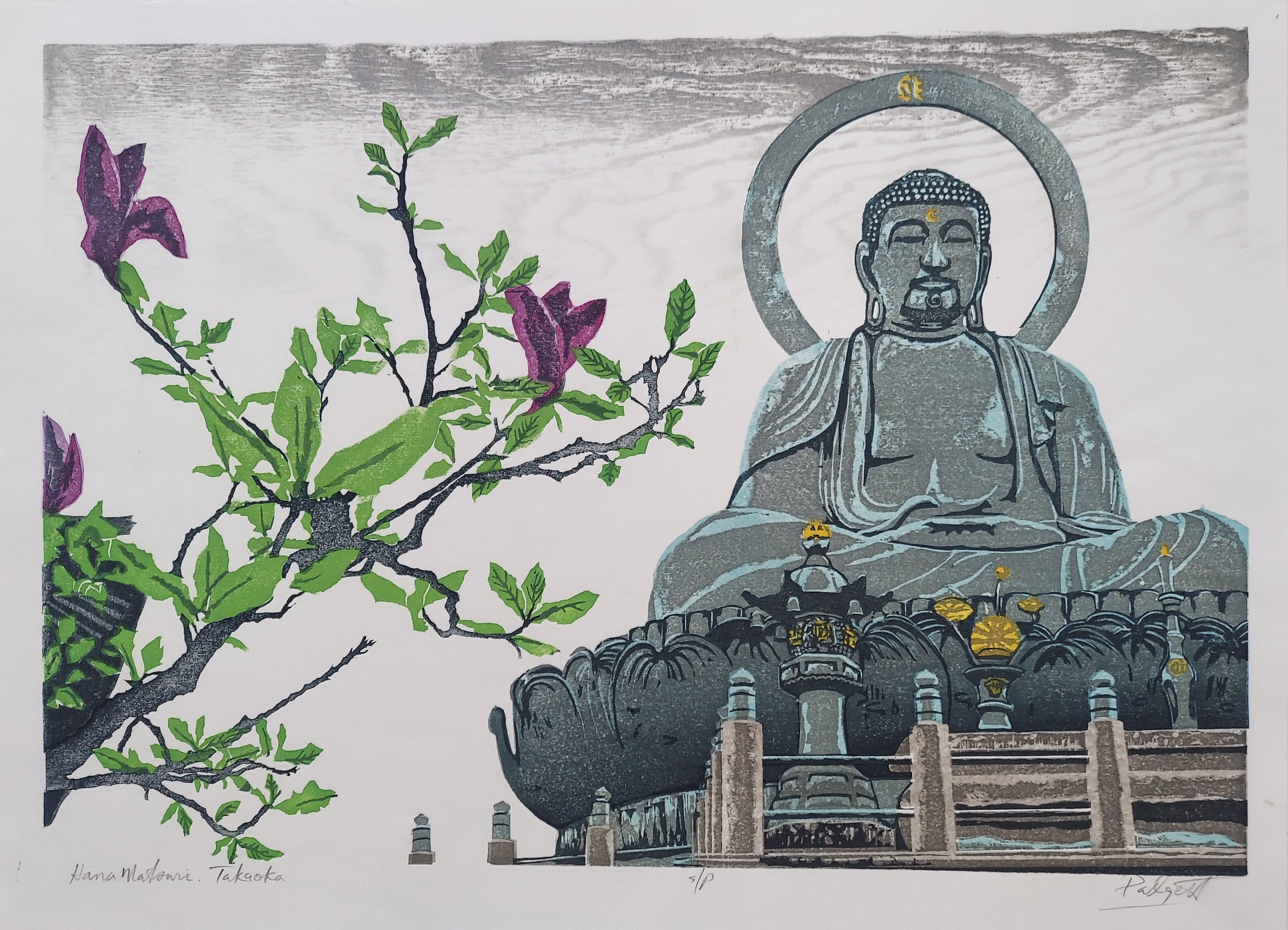
Hanamatsuri - Takaoka (2007)
(colored woodblock print)
Image courtesy of Walter Padgett

All of Padgett's woodblock prints are self-carved and self-printed.  His printing matrix is usually Japanese shina plywood, although other woods may be employed when he wants texture.  He uses traditional Japanese brushes and barens to ink and print his blocks.  Although he used tube watercolors for many years, since 2003 he grinds and mixes his own water-based pigments, unless he needs specific colors or to print very small areas.  (His early woodcuts, however, were inked with oil relief ink, hand-burnished with a wooden tool.)  He usually prints on expensive white or natural Echizen Kozo paper. 

Rinnoji - Miyagi (2004; 2005)
(colored woodblock print)
Image courtesy of Walter Padgett

Although Padgett carves and prints in the Japanese manner, his design development process is somewhat different from the norm, especially when depicting actual specific landscapes or historical buildings.  He seldom creates a true "key block" which outlines everything in the design.  Instead, he generally starts with one or more of his own color slides taken from the actual site in question, which he reverses, projects onto drawing paper, and copies by hand (so that it will eventually be printed in the original direction).  However, rather than gluing the master drawing to the woodblock, carbon paper is used to transfer the master drawing to the woodblock.  Additional tracing drawings are prepared that will provide details to be imparted by the color blocks.  (Other permutations may occur, such as using tracing paper to copy details from printed photographs or, rather than reversing the slide, flipping the tracing paper over before using carbon paper to transfer it to the block.)  Padgett will then carve along the lines of the transferred master drawing as needed for accuracy of shapes and edges, and freely carve other areas where textural effects such as grass, bark on trees, clouds, shading effects, etc.   The result is an image partially based on nature and partially based on inventive interpretation.

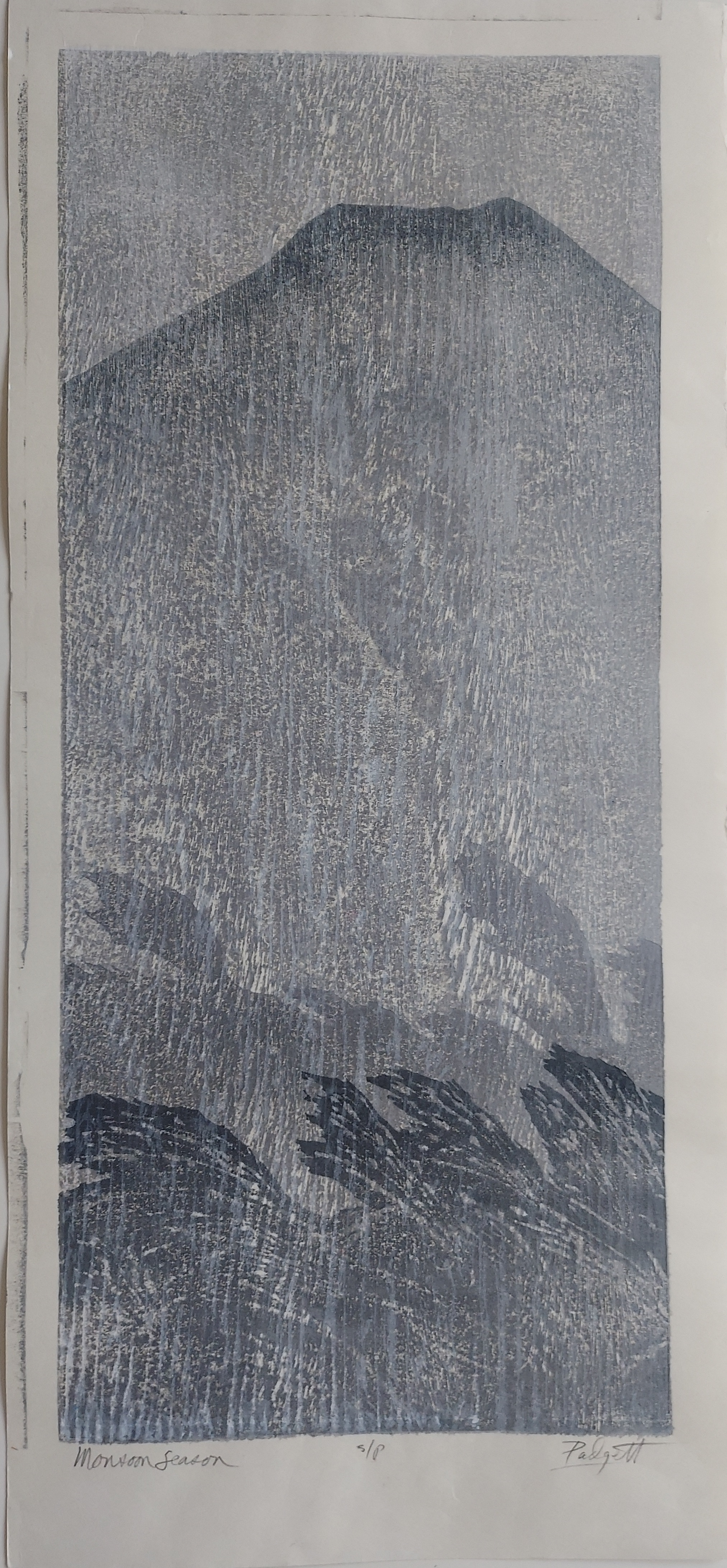
L: Monsoon - Fuji (2007; 2008) (colored woodblock print)
R: Monsoon Season (2011) (monochrome woodblock print)
Images courtesy of Walter Padgett

Padgett designs his blocks to incorporate a lot of overlapping of areas to create composite colors and textures, and overprints to build up richness of color.   To achieve this result, instead of pasting printings from a key block onto the color blocks, he retraces the edges of shapes as needed with the baren through the tracing paper and develops the color scheme block to block.  However, because the use of tracing papers is not as accurate as the use of a hanshita drawing, he needs to make multiple test prints of this color blocks to identify discrepancies between the blocks and the problem areas prior to the actual inking of the blocks.  The carbon paper printing enables him to do this in monochrome.  Carbon paper never prints solid black/dark blue except possibly in linework, and functions almost like pigment in that values can be tested.  The carbon printing of one area or shape, overlapping another, actually produces a combination value very similar to transparency pigment printing.

Red Fuji (2004; 2006)
(colored woodblock print)
Image courtesy of Walter Padgett
 
Relying on carbon paper printing of area onto tracing paper (burnishing the paper with carbon paper face up), Padgett works through the tracing paper to transfer corrections or additions back onto the blocks by flipping the carbon paper back face down.  He can check alignments this way, can print in new additions to the design, and can see how he likes them as he goes along.  As a result, the tracing paper sheets form an integral record of the development of the print design progressively.  (Part 2 of this article will illustrate this developmental process in detail with regard to Padgett's Toyokawa Atari print.)

Toyokawa Atari (2006; 2015; 2021; 2022)
(colored woodblock print)
Personal Collection (#5/200)

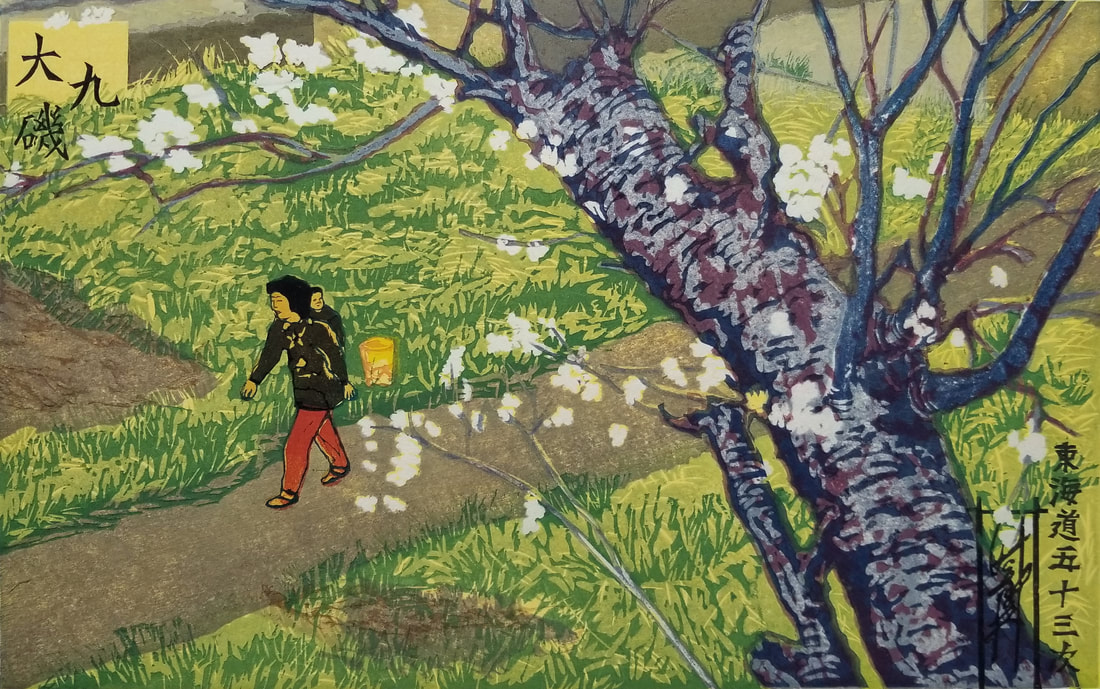
Some of Padgett's prints bear a signature (sometimes hidden) inside the borders of the print, such as in his "Red Pajamas Over Mt. Fuji" and in all of his Tokaido prints.  Although it looks like highly stylized kanji, it is actually his signature printed in reverse.  Nonetheless, Padgett tells me that two Japanese individuals have erroneously translated this writing as "Fukuroi," which coincidentally is Station 27 [28] of the Tokaido.

Padgett's reversed signature

A word now about Padgett's print editions.   Some of Padgett's prints are numbered, and a few of his Tokaido series prints have been produced in editions of 200 (though he says it is doubtful that he will ever print all 200 copies "so the edition ends when the artist dies").  Moreover, even if he has initiated an edition, he reserves the right to make alterations to the blocks or to the color scheme before the edition is completed.   Most of his prints, however, are labeled "s/p," which means "state proof."  He typically will start out printing ten or twenty copies at a time, release them to the public, and then gauge his own (and the public's) reaction to them.  That will lead him to produce further batches of experimental printings in which, for example, certain details may be added (or dropped) over time, or different color schemes may be tried out.   His "Miya Canal" print is one such example, which was printed in four major different color schemes of radical variation over the course of several years.   Each version had its own development, and the final version was achieved only because of the experimental development work on the earlier three states.

Example of "State Print" inscription

Here are the other Tokaido series prints Padgett has commercially released to date. ("Toyokawa Atari" is Tokaido-adjacent, being only a couple of miles from Station #34 [35] Yoshida and Station #35 [36] Goyu.)  The dates provided are the years that various versions were first printed.  With one exception (Sakanoshita - Keeper of the Shrine), no attempt has been made to illustrate each variation of a given design.

Totsuka - Boy's Festival (1986; 1995; 1997; 2008)
Tokaido Series #6
(colored woodblock print)
Image courtesy of Walter Padgett

Oiso (2002; 2004; 2008)
Tokaido Series #9
(colored woodblock print)
Image courtesy of Walter Padgett

Odawara Castle (1993; 1999; 2006)
Tokaido Series #10
(colored woodblock print)
Image courtesy of Walter Padgett

Mishima (2001; 2002; 2008; 2012)
Tokaido Series #12
(colored woodblock print)
Image courtesy of Walter Padgett

Cemetery at Numazu (1986; 1993; 2003; 2006)
Tokaido Series #13
(colored woodblock print)
Image courtesy of Walter Padgett

Ejiri - Pines of Miho Bay (1994; 1996; 2006)
Tokaido Series #19
(colored woodblock print)
Image courtesy of Walter Padgett

Nissaka, Green Tea Fields (1989; 1994; 1995; 2008; 2021)
Tokaido Series #26
(colored woodblock print)
Image courtesy of Walter Padgett

Kakegawa Castle (1997; 2001)
Tokaido Series #27
(colored woodblock print)
Image courtesy of Walter Padgett

Kakegawa - Makino Iron Works (1996)
Tokaido Series #27
(colored woodblock print)
Image courtesy of Walter Padgett
 
Mitsuke - Tenryu River (1995; 1997; 2005)
Tokaido Series #29
(colored woodblock print)
Image courtesy of Walter Padgett

Shirasuka (2021)
Tokaido Series #33
(colored woodblock print)
Image courtesy of Walter Padgett

Miya Canal (1986; 1987)
Tokaido Series #42
(colored woodblock print)
Image courtesy of Walter Padgett

Sakanoshita - Keeper of the Shrine (1995; 1997)
Tokaido Series #46
(monochrome woodblock print)
Image courtesy of Walter Padgett

Sakanoshita - Keeper of the Shrine (2004)
Tokaido Series #6
(colored woodblock print)
Image courtesy of Walter Padgett

Tsuchiyama (2007?; 2008; 2010)
Tokaido Series #50
(colored woodblock print)
Image courtesy of Walter Padgett

Minakuchi, Traditional Houses (1995; 1996; 2006)
Tokaido Series #51
(colored woodblock print)
Image courtesy of Walter Padgett

Kusatsu - Lake Biwa (2006; 2021)
Tokaido Series #53
(colored woodblock print)
Image courtesy of Walter Padgett

Of course, not all of Padgett's woodblock prints feature Japanese landscapes.  Many depict scenes such as Yellowstone Bison, Hart Mountain, and Mt. Rainier, as one might expect of a Pacific Northwest artist.  His work can be found in the permanent collections of such Oregon institutions as the Portland Art Museum, the University of Oregon's Jordan Schnitzer Museum of Art, the Grant Pass Art Museum, and the Oregon State University Library, as well as other venues ranging from the Wichita Art Museum to the Kakegawa City Museum in Japan and the National Museum of Jordan.

Rainier  - Winter (2001*)
*a number of color versions printed spontaneously at different times
(colored woodblock print)
Image courtesy of McClain's Printing Supplies

Stay tuned for Part 2 which will analyze the development of Padgett's Toyokawa print.  My sincere thanks to Walter Padgett for graciously answering my questions about his work and taking the time to explain his printmaking methodology.   More information about Padgett's career and artwork can be found on his website: http://www.waltpadgett.com/.

Walter Padgett (c. March 2019)

If a comment box doesn't appear below, click on this link instead: http://easternimp.blogspot.com/2022/05/japan-comes-to-oregon-tokaido-road.html.

Friday, September 04, 2020

Lilian Miller Collection

Readers of the blog may be interested to learn that Castle Fine Arts has acquired a private collection of 48 Lilian May Miller estate works owned by Miller descendant.  The collection includes many of her most famous woodblock prints, as well as a number of early paintings and drawings, a handful of which are shown below:

Korean Junks at Sunset (1928) by Lilian Miller
Courtesy of Castle Fine Arts
(colored woodblock print diptych

Flowers - Still Life (1909) by Lilian Miller
Courtesy of Castle Fine Arts
(ink and watercolor on paper, from an Album of Flowers)

View of Mt. Fuji, From an Inn at Hayama (1914) by Lilian Miller
Courtesy of Castle Fine Arts
(pen and ink drawing)

The collection also includes some uncatalogued prints, trial prints, and color variants.  I have added those to my prior post entitled "Lilian Miller's Uncatalogued Prints."

Rain Blossoms, Japan - A (Grey) (1928) by Lilian Miller
Courtesy of Castle Fine Arts
(colored woodblock print)

If you buy anything from Richard Castle, be sure to mention that I sent you his way.


Saturday, July 04, 2020

Elizabeth Keith's Old Korea

In a prior post, I mentioned my friend Professor Young-dahl Song's Korean text version of Keith's book Eastern Windows that included as an appendix a catalog of Keith's prints and paintings known to Professor Song as of 2012.  Recently, Professor Song has found a Korean publisher to reissue Elizabeth Keith's 1946 book Old Korea (written with her sister, Elspet Keith Robertson Scott), which has not been in print anywhere since 1947.  Used copies of the first edition typically fetch several hundred dollars in today's market.  In addition to the English language version of Old Korea, Professor Song has also published a  companion Korean language translation of Old Korea.

English language readers would normally not be particularly interested in a foreign language version of Old Korea, but they should.  First of all, although the Korean language version of Old Korea is available separately, the only way to buy the English language reissue is to buy both books as a set (a bargain as the publisher only charges an extra $10.00 for the English language version).  More importantly, this is an expanded 375 page version of the approximately 110 page original book.

Admiral Yi Sun-sin by Elizabeth Keith
(watercolor)

The Korean version (printed on higher quality paper) includes all of Keith's paintings and prints on Korea known to Professor Song as the publication date.  Most of the illustrations are in color and take up an entire page.  The majority did not appear in the original book, others did but not in color as here, and the ones that were in color in the original book are reproduced more sharply and vividly than in the English language reissue.  For the benefit of Western readers, all the prints and paintings are captioned in English.

New Year's Shopping, Seoul (1921) by Elizabeth Keith
(woodblock print and original watercolor design)

Particularly interesting to see are the original drawings and watercolor studies for many of Keith's woodblock prints.  The expanded Korean text additionally includes Professor Song's article on the life and art of Elizabeth Keith.  The book ends with a visual thumbnail index of all the artwork referencing the page(s) where larger versions can be found and a bibliography that is partly in English.

 Professor Young-dahl Song

This book and other books by Professor Song relating to Elizabeth Keith can be ordered in the U.S. from Bandi Books US in Los Angeles.  However, since their website is in Korean, readers may find it easier to place their order by phone than to navigate the website.  Copies are currently being sold on eBay for twice the list price, so caveat emptor.

Thursday, December 26, 2019

Chiura Obata's Miniature Prints

I'll get to Obata's miniature prints in a moment, but I wanted to alert readers to a worthwhile exhibition at the Smithsonian American Art Museum (SAAM) in Washington, D.C. entitled "Chiura Obata: American Modern, which runs until May 25, 2020.

Grand Canyon (May 15, 1940) by Chiura Obata
Amber and Richard Sakai Collection
(watercolor on silk)

The Smithsonian show is the final stop of a five-museum tour, and the only venue east of the Rocky Mountains.  Guest curated by ShiPu Wang, professor of art history at the University of California, Merced, the exhibition was previously on display in Santa Barbara, Salt Lake City, Sacramento, and Okayama, Japan.  The D.C. presentation has been coordinated by Crawford Alexander Mann III, SAAM’s curator of prints and drawings, and additionally draws upon SAAM's own substantial holdings of Obata woodblock prints, paintings, and artifacts.

Lake Basin in the High Sierra (1930) by Chiura Obata
Proof circa state 99 of 107 impressions before the
title, the carver's name and printer's name were removed
Personal Collection
(colored woodblock print).

 
Full Moon, Pasadena, California (1930) by Chiura Obata
Personal Collection
(colored woodblock print)

This is SAAM's second Chiura Obata (1885-1975) exhibition, having mounted a show devoted to Obata's Yosemite prints in 2008.   All of Obata's woodblock prints published by Takamizawa Print Works in 1930 (including a few non-Yosemite subjects) can be found here on the Hanga.com website.  Collectively, they are among the most interesting woodblock-printed landscapes of the early Showa period, remarkable not only for their power and beauty but also for demonstrating Obata's range as an artist.   Some are naturalistic, some are expressionistic, and one, Foggy Morning, Van Ness Avenue, is manga-like in its presentation.  In Full Moon, Pasadena, California, the Takamizawa carvers and printers have produced a work of art that, to the untrained eye, looks more like an original watercolor than a woodblock print.

 
Point Lobos, Monterey, California (1922) by Chiura Obata
Private Collection
(color ink on silk two-panel screen)

 
Maiden of Northern Japan (1931) by Chiura Obata
Crocker Art Museum
(mineral pigments on silk)

The current exhibition includes some the Yosemite prints featured in the prior exhibition (including the original watercolor and a complete set of progressive proofs for Evening at Carl Inn), but also surveys Obata's entire artistic career, from his childhood sketchbooks, to his illustration work, to his sumi ink and color paintings and screens.

 
 Landslide (1941)
Private Collection
(sumi and watercolor on paper)

 
 Talking Through the Wire Fence (July 1942) by Chiura Obata
Private Collection
(sumi on paper)

 
Dust Storm, Topaz (Mar. 13,1943) by Chiura Obata
Private Collection
(watercolor on paper)

In particular, the exhibition covers Obata's depictions of internment camp life at the Tanforan Assembly Center and the Topaz War Relocation Center during World War II, and his depictions of the aftermath of the atomic bombing of Japan.

 
Devastation (1945) by Chiura Obata
Private Collection
(watercolor on paper)

Obata's prints made at the Takamizawa studios are his best known prints, but they are not the only woodblock prints that he designed.  Lesser known are series of miniature prints that Obata had made in the 1950s and 1960s during a time when he was conducting goodwill tours of Japan for Americans.  Some were clearly intended to be used as invitation covers or holiday cards; others may have been intended as gifts.  As far as I know, these miniature prints have never been catalogued, and most are only known by purely descriptive titles.

 
Close up of the bird print on the World Landscape series 
portfolio cover (1930) by Chiura Obata
Published by Takamizawa Print Works
Personal Collection
(colored woodblock print)

Obata's most famous miniature prints (or, at least, the most charming ones) belong to what are colloquially referred to as the Japanese Garden series published by tbe Uchida Art Co. Ltd.  Many of these prints are only known today in trial proof form, but the final version have printed titles on the prints (or on the backing cards upon which they may have been mounted).   Seven numbered designs are specifically known to exist but, based on the stylistically-related proof designs I have found, I suspect roughly a dozen different designs were made.

#2  The Moon light at Shiho-En (c. 1950s/1960s) by Chiura Obata
Personal Collection
(colored woodblock print)


#3 Early Summer Breeze at Shiho En (c. 1950s/1960s) by Chiura Obata
Personal Collection
(colored woodblock print)

Daikan (c. 1950s/1960s) by Chiura Obata
Personal Collection
(watercolor)

#4 Daikan (c. 1950s/1960s) by Chiura Obata
Personal Collection
(colored woodblock print)

Note: The card inscription says "Standing on the terrace of Daikan So, one glance takes in the great panoramic view of more than seventy miles from San Jose and the Peninsula in the south to Marin County in the north.  From the northwest a sea breeze softly move the fresh green willow leaves.  The pet Persian cat, Muffie, lazily occupies the sofa; one the wooden table stands a Japanese dwarf cypress tree; along the low wall potted begonias give red and golden lively colors which sparkle.  To the right an aged bronze lantern adds more beautiful harmony for a restful feeling."

 
#5 Shiho En (c. 1950s/1960s) by Chiura Obata
Personal Collection
(colored woodblock print)

#6 Gate of Serenity (c. 1950s1960s) by Chiura Obata
Courtesy of Floating World Auctions
(colored woodblock print)

#7 Daikan So (c. 1950s/1960s) by Chiura Obata
Courtesy of Floating World Auctions
(colored woodblock print)

[Deer in a Japanese Garden] (c. 1950s/1960s) by Chiura Obata
Personal Collection
(colored woodblock print)

 
[Garden Scene with Footbridge and Stone Lanterns] (c. 1950s/1960s) by Chiura Obata
Personal Collection
(colored woodblock print)

 The Great View of Daikan So (c. 1950s/1960s) by Chiura Obata
Personal Collection
(colored woodblock print)

 
[Exterior of a Home] (c. 1950s/1960s) by Chiura Obata
Personal Collection
(colored woodblock print)

 
[Living Room] (c. 1950s/1960s) by Chiura Obata
Personal Collection
(watercolor)

Note: Unlike the watercolor for Daikan, which is print-size), this watercolor is more than twice the size of the final print.

[Living Room] (c. 1950s/1960s) by Chiura Obata
Personal Collection
(colored woodblock print)

Entering Daikan So (c. 1950s/1960s) by Chiura Obata
Courtesy of Clars Auction Gallery
(colored woodblock print)

Although not part of the Japanese Garden series, there are a number of other prints that Uchida produced based on Obata designs:

[Leaping Salmon] Season's Greetings Kim And Masao Obata (c. 1950s/1960s) 
by Chiura Obata
Personal Collection
(colored woodblock print)

[Rainbow Trout] Season's Greetings Kim & Masao Obata (c. 1950s/1960s) 
by Chiura Obata
Personal Collection
(monochrome woodblock print on textured gold-colored paper)

[Garden Scene] (circa 1950s/1960s) by Chiura Obata
Personal Collection
(colored woodblock print)

 [Dragon Ball] (c. 1950s/1960s) by Chiura Obata
Personal Collection
(woodblock print in black and grey)

Note:  This card was probably made for the Year of the Dragon, which would date the print to either 1952 or 1964. 

[Snow at Golden Pavilion] (c. 1950s/1960s) by Chiura Obata
Personal Collection
(woodblock print in black and grey)

 [Mt. Fuji] (c. 1964) by Chiura Obata
Private Collection
(woodblock print in black and grey)

 Note: This print was used for an invitation to a film showing of Japan brushwork demonstration and exhibition of original watercolors by Obata on July 28, 1964 at the Carmel Women's Club.

[Pine Tree on Cliff] (c. 1969) by Chiura Obata
Private Collection
(woodblock print printed n black and grey)

 Note: The greeting card by the Obatas is dated 1969.

Obata also produced a few miniature prints with other publishers.  The following print was used as the portfolio cover illustration for From The Sierra To The Sea, a portfolio of eleven paintings in watercolor and sumi  accompanied by printed translations from the artist's poetry, published in Berkeley, California by Archetype Press in an edition of 50 copies (of which only 25 copies were for sale).   The print was made on a hand press of Wilder and Ellen Bentley in 1937.

Yama yori umi ni (From The Mountains to the Sea) (1937) by Chiura Obata
Private Collection
(woodblock print printed in brown)

 
Yama yori umi ni (From The Mountains to the Sea) (2001) by Chiura Obata)
Personal Collection
(woodblock print printed in brown)

Note: The print found in From The Sierra To The Sea was reissued in 2001 as a commemorative broadside accompanying a poem by Gary Snyder to benefit the International Rivers Network on the occasion of the lecture The Poetry and Politics of Rivers by Julie Tsai featuring Gary Snyder at the Second Annual International River Network Conference in San Francisco (May 17, 2001).  It was designed and printed by Morning Glory Press in an edition of 100.

  
[View from Berkeley Hills]  (c. 1950s/1960s) by Chiura Obata
Private Collection
(unknown medium)

Note: I am including this print out of an abundance of caution.  It was commissioned by the City Council of the City of Berkeley.  It is probably an offset lithograph and not a woodblock print or stone lithograph.

It should also be noted that Obata made two miniature prints with the Takamizawa Studio in connection with the publication of his World Landscape print series.  One is a reduced size lithographic reproduction of his portrait of Madame Talia Savanieva.

Before Singing (Madame Talia Savanieva) (1930) by Chiura Obata
Personal Collection
(lithograph reproduction printed on silk and mounted on a shikishiban board)

Note: The back of the shikishiban board is inscribed "Tokyoa Tango Shunkumen Senden Taikai."

The other is a small woodblock print of a bird, used on the portfolio cover and individual print folders for the prints in the World Landscape series.  Minor color variations are known to exist.

  
World Landscape series print folder cover (1930)
by Chiura Obata
Personal Collection
(colored woodblock print)

World Landscape series print folder cover (1930)
by Chiura Obata
Courtesy of the Smithsonian American Art Museum
(colored woodblock print)

Finally, although they are not actually "miniature" prints, it is worth noting that Obata designed a number of large Chinese horse prints.
 
[Galloping Chinese Horse with head turned to face right] (c. 1950s/1960s)
by Chiura Obata
Personal Collection
(watercolor)
  
[Galloping Chinese Horse with head turned to face right] (c. 1950s/1960s)
by Chiura Obata
Personal Collection
(woodblock print printed in black and grey)

  
[Galloping Chinese Horse with head turned to face left] (c. 1950s/1960s) 
by Chiura Obata
Personal Collection
(watercolor)

 
[Galloping Chinese Horse with head turned to face left] (c. 1950s/1960s)
by Chiura Obata
Personal Collection
(woodblock print printed in black and grey)

The above two prints were published by Uchida.   However, Obata also made eight additional Chinese horse prints with the publisher Baba Nobuhiko, which are said to have been issued in numbered editions of 100.  To date, I have only located images of two of such horse prints:

[Standing Chinese Horse with head turned to face left] (c. 1950s?) 
by Chiura Obata
Private Collection
(woodblock print printed in black and grey)

[Galloping Chinese Horse facing left] (c. 1950s?)
by Chiura Obata
Private Collection
(woodblock print printed in black and grey)

A third print has surfaced, possibly also published by Baba Nobuhiko, although it bears a pencil inscription of "Ed. 5."

[Flying Horse] (c. 1950s?)
by Chiura Obata
Personal Collection
(woodblock print printed in black and grey)

If readers are aware of further miniature or non-canonical woodblock prints by Chiura Obata, please contact me at the address at the upper right of this page.